
Category: Soberanía alimentaria

The Imposition of Brazilian Agribusiness and the Supression of Family Farming, With Government Support

April 3, 2013

The previous governments during the period of redemocratization were left with the important task of promoting the social uses of rural land and urban property and it was assumed that Lula was the most qualified to meet this demand, given his proximity to the MST. However, the number of expropriations in his two terms was significantly lower than his predecessor, the Social Democrat Fernando Henrique Cardoso. Lula expropriated only 1,990 properties compared to the 3,532 under President Cardoso.
Quinoa: ¿Será comprar o no comprar la pregunta correcta?

February 19, 2013

Últimamente hemos escuchado mucho acerca de la quinua.[i] Mientras que los consumidores de EE.UU. la valoran como un “súper alimento” delicioso, existe una creciente ansiedad sobre el impacto del boom de la quinua en los países andinos, y en particular en Bolivia, el primer productor mundial. Los medios de comunicación en el Norte se han centrado principalmente en el hecho que la demanda global está provocando una subida del precio de la quinua, situando al alimento fuera del alcance de los pobres—incluso los mismos productores de quinua—obligándolos a consumir productos de trigo refinado, como el pan y el fideo, que son más baratos pero que tienen bajo valor nutricional. Según esta lógica, algunos sugieren, los consumidores del Norte deberían boicotear el “grano de oro” para bajar su precio y hacer que sea accesible de nuevo para los consumidores pobres.

Ismael and Manuelita Died in Defense of Three Basic Rights

December 12, 2012

The three most threatened human rights on the planet today are the right to water, the right to a healthy environment, and the right to food. In Chihuahua these are ever-growing threats that have claimed two victims already. Ismael Osorio and Manuelita Solis, his wife, were murdered near Ciudad Cuauhtémoc on Oct. 23 while they defended these rights.

What really happened in Curuguaty?

December 12, 2012

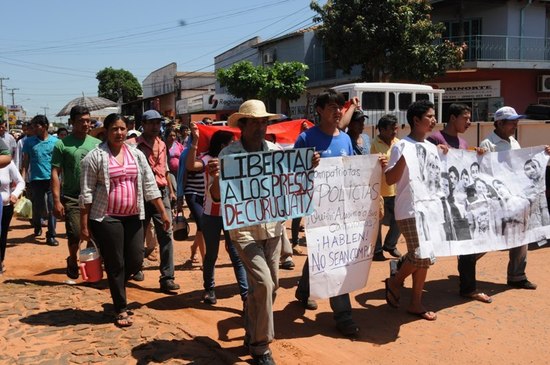
What happened in Curuguaty? That’s the question that has been lingering in the minds of many Paraguayans after the controversial death of Vidal Vega, the peasant leader who was a key witness to the investigations of the Curuguaty massacre. Vidal Vega, 48, leader of a landless peasant movement in Paraguay was shot four times on December 1 2012, by bullets from a 12-gauge shotgun and a 38-caliber revolver fired by two unidentified men who sped away on a motorcycle, according to an official report prepared at the police headquarters in the provincial capital of Curuguaty.

Los derechos amenazados que defendieron Ismael Solorio y Manuelita Solis

December 3, 2012

Los tres derechos humanos más amenazados en el planeta, de hoy en adelante son el derecho al agua, al medio ambiente sano y a la alimentación. En Chihuahua la amenaza es mayor y ya produjo las dos primeras víctimas en dos personas que se comprometieron hasta lo último en su defensa: Ismael Solorio y Manuelita Solís, su esposa, asesinados el 23 de octubre cerca de Ciudad Cuauhtémoc.

Monsanto’s bile against Mexico’s honey

November 1, 2012

Monsanto’s bitter seeds have given another blow to the Mexican honeycreepers that had previously succeeded in stopping short the transnational corporation’s plan to plant 253,000 acres of transgenic soybeans in the Yucatan Peninsula that would have jeopardized beekeeping in the region, the main livelihood more than 25,000 families.

Venezuela joins Mercosur: A New Strategic Alliance

October 26, 2012

Venezuela’s entry into Mercosur has had interpretations centered on the economic and commercial aspects, but the most important is a geopolitical and geo-energetic matter. The region becomes a food and hydrocarbon power pointing to the Caribbean. On July 31 when the entry of Venezuela into Mercosur was decided in Brasilia, presidents Dilma Rousseff and Cristina Fernández emphasized the importance of the new Mercosur in the framework of the world crisis that is summed up in the birth of a “new pole of power.”

The Fight for Corn

October 25, 2012

In an era of food crisis, the fight for corn has intensified, and the importance of this grain – a staple of the diet of Mexico and a large part of the world – has been revealed to the fullest extent. The scenario we are faced with is a battle between a culture that revolves around the material and symbolic production of corn, as well as the cultural, social, and historical value placed upon this crop by humankind, and the network of commercial and political interests that sees this prodigious crop simply as another way to increase power and profit by means of plundering its native lands.

Yaqui Resistance: Against the Aqueduct, Agricultural Chemicals and Transgenics Crops on their Ancestral Lands

October 23, 2012

According to tribal leaders, the economic, ecological, and social stability of the Yaqui tribe is being threatened by the construction of the Sonora Sí (Sonora Yes!) project that is being imposed within its territory with the backing of the state government. “The aqueduct is an unfair, illegal project, supported by the federal government,” says Juan Piña, Yaqui tribal governor, expressing his concern about the situation in the country and especially in the state of Sonora.