Argentina’s Warning on Sovereign Debt
September 30, 2014
The sum of the sovereign debt emissions by all of the world’s treasuries constitutes an enormous financial market concentrated in a few principal currencies and legal jurisdictions.

The sum of the sovereign debt emissions by all of the world’s treasuries constitutes an enormous financial market concentrated in a few principal currencies and legal jurisdictions.
The regions in the south and southeast of Brazil are the richest areas in the country and the most industrialized in Latin America. The southeast alone is responsible for 60% of GDP, and thus, in this region 90% of the population is concentrated in urban zones. In this geography of modernity there is also an indigenous territory that is in its death throes, the land of the Guaraní.
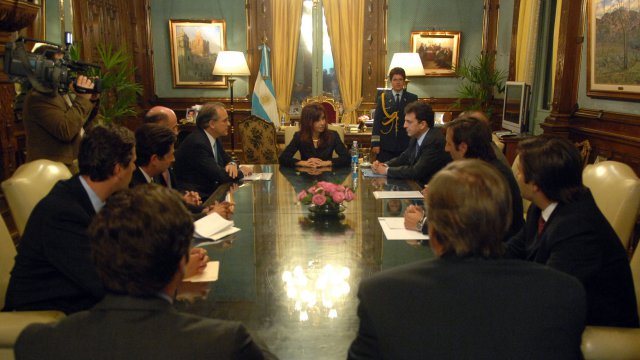
The Argentine government made another attempt to resolve the conflict over its debt on August 20, when President Cristina Fernandez launched a legislative proposal to make Buenos Aires the place of payment for creditors and get out from under U.S. legislation that has trapped the country in a financial-judicial labyrinth.
Two years after the fall of the Fernando Lugo government and one year after the rise of Horacio Cartes of the Colorado party, social movements show signs of rebuilding, with remarkable leadership of the campesino movement facing agribusiness and repression.
En pleno desarrollo de la Copa Mundial, Jamil Jorge opinaba sobre el auspicio de Brasil desde su casita de ladrillos en Vidigal, favela que mira hacia los barrios más elegantes de Río: “La Copa Mundial beneficia sólo a personas e instituciones con dinero, no a la gente como yo”.
When governments facilitate the business of multinationals and leave communities unprotected– as with mining – those communities must defend themselves by their own means, through self-defense organizations, mobilizing affected communities, or creating new ways to prevent being evicted from their own territories.
Seven years ago when Brazil was announced as FIFA’s selected host country for this year’s World Cup, Brazilians celebrated in the streets. on the eve of the tournament, polls showed that most people in the very country that has enjoyed more World Cup victories than any other no longer wanted to host the tournament whose final match played out July 13. Why the drastic change in public opinion, over a game Brazilians clearly adore?
A meeting in Popayán, capital of the Cauca department, was the excuse for learning about a complex and violent reality. The war between the military, paramilitaries, guerrillas, and drug traffickers is intertwined with savage extractivism, with illegal mining its worst expression.
Started during the military dictatorship, the Carajás Project has, in three decades, made Brazil a mining power. Social movements, ecclesial groups and human rights […]
As the World Cup nears, the American company Academi, formerly Blackwater, carried out training of Brazilian military personnel and federal police in April as part of a military cooperation agreement between Brazil and the United States signed in 2010.