The World in Focus | Analysis column
The acts of aggression and interference in the Western Hemisphere since Donald Trump took office in January this year aim to destroy the sovereignty of countries in the region and turn them into subordinate states serving his interests. These actions are part of U.S. foreign policy toward our region, and now they’ve been spelled out clearly in US National Security Strategy (NSS) that the White House released on Friday.
The strategy calls for increasing military presence in the Americas and eliminating China’s presence in strategic sectors, particularly deep-water ports and fifth-generation (5G) wireless technologies. It uses the pretext of “narco-terrorism” to encroach on countries that do not unconditionally align with U.S. interests.
Can we believe that the U.S. government’s goal is to fight drug trafficking, ensure democracy, and respect human rights after Trump pardoned convicted drug trafficker Juan Orlando Hernández this week? The former Honduran president was serving a 45 year sentence for cocaine trafficking and illegal possession of arms, handed down in 2024 by the New York District court after years of investigation. As we pointed out last week in this column, President Trump announced the pardon for Hernández, who has been released, as part of his call on Hondurans to vote for Nasry Asfura of Hernandez’s National Party and threatened repercussions if they did not. At this point, Asfura has a slight lead over his rival Salvador Nasralla of the Liberal Party, amid serious allegations of fraud to the point that the country’s prosecutor’s office will investigate whether there was hacking in the presidential elections.
The hypocrisy is not new. Trump also ignored the fact that Argentine president Javier Milei’s main candidate in the province of Buenos Aires, José Luis Espert, had ties to Fred Machado, a businessman arrested and facing extradition to the U.S. on charges of drug trafficking, fraud, and money laundering. He also conditioned U.S. aid on a victory for Milei’s extreme righty party in the Argentine midterms held in October.
That same month, he accused Colombian President Gustavo Petro–without evidence–of being “a drug trafficking leader”, cut off subsidies to Colombia and included Petro and his family in the registry of Specially Designated Narcotics Traffickers of the U.S. Office of Foreign Assets Control (OFAC). Trump announced Dec. 2 that any country involved in prohibited drug production or trafficking is “subject to attack”, while specifically citing Colombia. Petro is the only president in the region who has strongly condemned the extrajudicial killings of the crew members of the 22 boats bombed by the United States and has repeatedly pointed out that that U.S. aggression and military encirclement of Venezuela is aimed at overthrowing President Maduro and seizing its oil.
The Trump Corollary to the Monroe Doctrine

In the prologue, Trump asserts that during the first nine months of his term he has rescued the country and the world from the brink of catastrophe. “The United States is once again strong and respected, and because of that, we are building peace throughout the world,” he boasts in the document. His strategy, he claims, is designed to ensure that the U.S. “remains the greatest and most successful nation in the history of mankind, and the home of freedom on earth.”
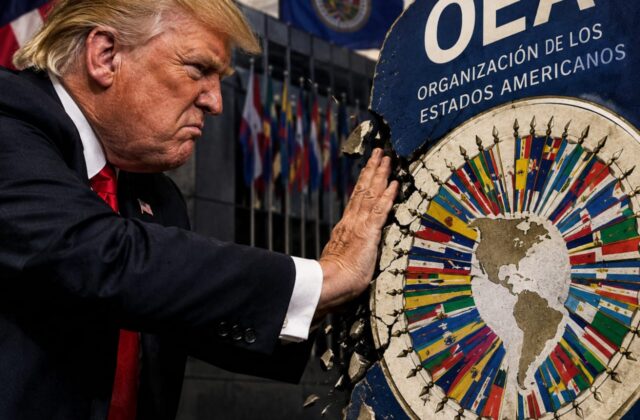
The strategy considers China the main U.S. rival, and calls to continue or increase intervention in our region. Trump proposes the Trump Corollary to the Monroe Doctrine, proclaimed two centuries ago when the United States claimed Latin America to block rival powers, then European.
The blatant interference of the United States in our region has been evident since the first day of his term when he renamed the Gulf of Mexico the “Gulf of America”, and exerted pressure on Panama to withdraw from China’s Belt and Road Initiative (BRI) infrastructure project and forced the departure of two Hong Kong companies operating in the canal. He also declared cartels “foreign terrorist organizations” in Mexico, Ecuador, and other countries, which allows him to exempt power from certain authorizations to intervene militarily in other countries.
Trump literally states that, after years of neglect, the United States will reaffirm and apply the Monroe Doctrine to restore US preeminence in the Western Hemisphere to “protect our national territory and our access to key geographies throughout the region.” As if the U.S. government had jurisdiction over the region, it states that it will deny non-hemispheric competitors (i.e., China and, to a lesser extent, Russia) the ability to position forces or other threatening capabilities, or to own or control strategically vital assets, in our hemisphere.
Recruiting governments
The U.S. government’s objective for our region is summarized as “recruiting and expanding” governments in the region. This means assuring allied and consolidated regional leaders who can help create “tolerable stability in the region, even beyond the borders of those partners.” Such nations “would help us stop illegal and destabilizing migration, neutralize cartels, develop local manufacturing, among other things.” The new U.S. strategy explicitly states that “governments, political parties, and movements in the region that are broadly aligned with our principles and strategy will be rewarded and encouraged”.
Those “other things” not mentioned, such as subordination to its foreign policy, are the most important. Other supposed goals can be set aside among allied leaders, as seen in the outrageous pardon granted to convicted drug trafficker, former Honduran President Juan Orlando Hernández. The fight against drug trafficking in this context is a front for intervening in and destabilizing governments that do not automatically align themselves with the United States and instead attempt to assert their sovereignty.
In its eagerness to “recruit” governments, the Trump administration has already unscrupulously attempted to intervene in the rulings of the Brazilian and Colombian judiciaries.
In the first case, it labeled the trial against Jair Bolsonaro and other officials for attempting a coup in January 2022 and preventing Lula from assuming the presidency “a witch hunt” and imposed tariffs of up to 50% on Brazil.
In the Colombian case, the Trump administration publicly denounced Colombia’s justice system, as is customary when the defendants are allies of Trump, for sentencing former President Álvaro Uribe (2002-2010) to twelve years under house arrest. During Uribe’s rule, the so-called “false positives” took place, in which 6,400 innocent civilians were assassinated and illegitimately presented as guerrillas killed in combat in exchange for prizes and rewards under the framework of so-called “democratic security.” As if that were not enough, Uribe has been accused on numerous occasions by U.S. diplomats of having links to drug trafficking in the 1990s, according to declassified State Department documents.
The military encirclement of Venezuela and threats of invasion of Colombia, and other countries that refuse to fight Trump’s so-called drug war under U.S. command, are part of the Trump Corollary to the Monroe Doctrine, which translates into a greater military presence and aggression in the region.

The NSS also includes signing reciprocal trade agreements, after Trump halted several major agreements during his first term. These trade and investment agreements with the U.S. have not brought the prosperity promised to the countries that have signed them. The illusion of those who have not signed and now believe that they will prosper prevents them from seeing that the United States’ objective is to gain unlimited (i.e., libertarian) access to their natural resources, and flooding our region with light goods industry (without competition), which results in the destruction of national industrial infrastructure, growing informal economy, and the reversal of positive trade balances, where these exist, into negative ones. This has already happened in all the countries in the region that signed this type of agreement, with the exception of Mexico (due to its high degree of industrial integration with that country).
The document states that these agreements “will make it difficult for non-hemispheric competitors to increase their influence in the region”. This is true, but diversity in trade relations is something each nation should have the right to define, not a foreign power. As the icing on the cake, the strategy establishes that the United States will work “to strengthen our security alliances, from arms sales to intelligence sharing and joint exercises.”
Expanding influence
Under this concept, the aim is to expand a network of alliances in the region that will lead governments to consider the United States their preferred partner and (through various means) discourage their collaboration with others. This point notes that our region is home to numerous strategic resources that the United States should develop in collaboration with regional allies so that neighboring countries and the United States can prosper. With complete audacity, it announces that the National Security Council (of the United States) will immediately initiate a robust process to task its agencies with identifying strategic points and resources in the Western Hemisphere for joint protection and development with regional partners, with the support of the analytical arm of the Intelligence Community.
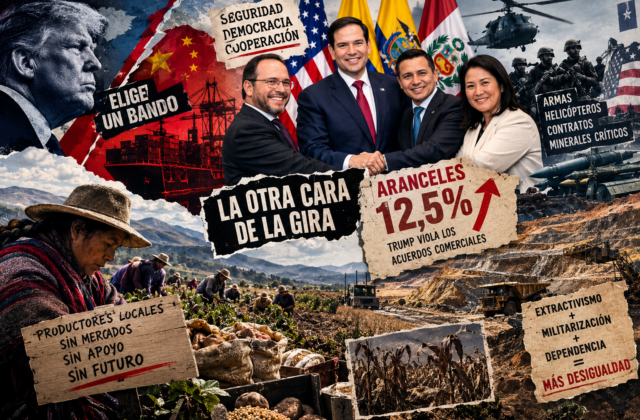
Further assuming that all of Latin America and the Caribbean belong to the U.S., the strategy denounces that “non-hemispheric competitors have made significant inroads into our hemisphere, both to harm us economically in the present and to harm us strategically in the future.” To counter this, the document states “the terms of our alliances, and the terms under which we provide any type of assistance, must be conditional on the reduction of adverse external influence, from the control of military installations, ports, and key infrastructure (such as the port of Chancay in Peru) to the purchase of strategic assets in a broad sense.”

The NSS claims that many governments are not ideologically aligned with foreign powers, but are attracted to doing business with them for other reasons, such as low costs and fewer regulatory obstacles, adding that the United States has managed to reduce foreign influence in the Western Hemisphere by demonstrating the hidden costs—in espionage, cybersecurity, debt traps, and others—that are implicit in some so-called “low-cost” foreign assistance.
In a childish tone, the strategy states, “in the Western Hemisphere, and around the world, the United States must make clear that U.S. goods, services, and technologies are a much better long-term investment, as they are of higher quality and are not subject to the same conditions as assistance from other countries.” Even as it heavily conditions all U.S. engagement, it implies Chinese involvement in political decisions outside its country, positing, “the dilemma that all countries must face is whether they want to live in a U.S.-led world, with sovereign countries and free economies, or in a parallel one, in which they are influenced by countries on the other side of the world.”
The Trump administration’s NSS requires all U.S. officials working in the region to exert pressure and offer incentives to partner countries to help U.S. companies compete and succeed, as Ambassador Lamelas does in Argentina. The document states that “the terms of our agreements, especially with countries that are most dependent on us and, therefore, over which we have the greatest influence, should be sole-source contracts for our companies. At the same time, we must do everything possible to expel foreign companies that build infrastructure in the region.
There is no doubt that the new U.S. National Security Strategy seeks to gain absolute control of the region and curb China’s growing presence, via a greater military presence that can be used at will under the guise of narco-terrorism, with the aim of exercising monopoly control over the region’s abundant natural resources, signing trade agreements, and achieving a certain level of prosperity that will curb multiracial migration to the United States and preserve its Anglo-Saxon culture.

“The World in Focus” is Ariela Ruiz Caro’s biweekly column for Mira: Feminisms and Democracies. Ariela Ruiz Caro is an economist with a master’s degree in economic integration processes and an international consultant on trade, integration, and natural resources at ECLAC, the Latin American Economic System (SELA), and the Institute for the Integration of Latin America and the Caribbean (INTAL), among others. She has served as an official of the Andean Community, advisor to the Commission of Permanent Representatives of MERCOSUR, and Economic Attaché at the Embassy of Peru in Argentina.