Venezuela: Trump’s bid to impose his authoritarian ideology in violation of international law

The world in focus | Analysis column

The military operation “Absolute Resolution” carried out by the United States in Caracas to kidnap President Nicolás Maduro and his wife, Congresswoman Cilia Flores, is the most serious, scandalous, and illegal acts of intervention by that country in the region in recent decades. This is the first time that the United States has launched a military attack on a South American country (previously it had only done so in Central America and the Caribbean islands), which highlights the significance of the “Trump Corollary” to the US National Security Strategy. The incursion, described by President Trump as “masterful,” left more than 80 dead, more than half of them belonging to the Venezuelan president’s security forces, 32 of them Cuban, and no casualties among U.S. forces.

Everything points to the presence of CIA infiltrators, at least in the upper echelons of Maduro’s security forces, which would have allowed the U.S. helicopters to move without any resistance from the Bolivarian Armed Forces. Some analysts believe that there were negotiations between Venezuelan government officials and the U.S. government, although the dust has yet to settle.

Donald Trump carried the burden of not having been able to overthrow Nicolás Maduro’s government during his first term, nor to banish China’s economic presence in our region. The imposition of Juan Guaidó as interim president (2019-2023), with his more than 50 diplomatic representations financed by the U.S. government; the creation in 2017 of the Lima Group–a group of twelve Latin American countries aligned with Trump that sought a peaceful solution to the political and humanitarian crisis in Venezuela; and the launch of the America Grows Initiative, a project to finance investment projects in infrastructure, telecommunications, and digital networks with the conditionality of limiting China’s presence, all failed miserably.

In August 2020, the White House National Security Council launched its strategic framework for Latin America and the Caribbean, which explicitly mentions China as an extra-regional enemy for “its malign influence in seeking to expand its market share, especially in 5G infrastructure, for Huawei and other technology companies, increasing financial dependence on China and exports of natural resources.” The document announces that the United States will counter “China’s economic aggression.”

In his second term, Trump continues to target China and Venezuelan oil. That’s why, since the end of August 2025, he has surrounded the country with more than 20% of his military fleet, which many experts describe as the largest deployment since the 1962 Missile Crisis. Several Caribbean islands (the Dominican Republic, Trinidad and Tobago, Aruba, and Curaçao) have been complicit in the deployment. These actions are in line with the role our region plays in the U.S. National Security Strategy published in November, which we discussed in a previous article.

_________________________________________________________________________________________

“With the traumatic kidnapping of the former Venezuelan presidential couple, the United States has dealt a severe blow to the world order based on international law and the United Nations Charter, taking us back to neocolonial times

_________________________________________________________________________________________

To invade Venezuela, Trump has had no problem violating the legality of his own country by not seeking the approval of Congress. Nor has he had any problem violating international law and the United Nations Charter under the protection of unfounded causes such as the accusation that Maduro leads the so-called Cartel of the Suns. The U.S. justice system itself declared that this organization does not exist, when Maduro and his wife were already imprisoned in New York.

Trump is consistent in his disrespect for institutions and international law. He openly states that it’s an obstacle to a great power. This week marks five years since January 6, when he encouraged and endorsed the assault on the Capitol to prevent President-elect Joe Biden from being sworn in. Upon returning to government, Trump has pardoned 1,200 people convicted of participating in the riot. The president not only endorsed the assault but, in coup-like behavior, called for the results in four states, including Georgia, to be overturned.

He also took classified documents from the Pentagon to his Mar-a-Lago residence, for which he faced prosecution. Trump has indicated this week that he wants to amend the Constitution so that he can be re-elected for a third term and that there will be a constitutional movement.

With the traumatic kidnapping of the former Venezuelan presidential couple, the United States has dealt a severe blow to the world order based on international law and the United Nations Charter, taking us back to neocolonial times, to the diplomacy of cannons, where only the power of the strongest prevails and military might tramples on the right of countries to self-determination. It also opens a new chapter in Venezuelan politics, which has suffered a severe blow to its sovereignty and the principles of Chavismo, in force for the last 26 years.

Gunboat diplomacy

Trump has revived the foreign policy strategy known as gunboat diplomacy, which was prominently used during 19th-century imperialism. This involves the use or threat of military force, especially naval force, to coerce or influence a weaker country and achieve political or economic objectives, such as securing concessions, favorable treaties, or preventing foreign interference, without resorting to all-out war.

In effect, the operation to kidnap Maduro and his wife began in late September when the U.S. sent warships and the aircraft carrier Gerald Ford, from where they bombed boats in the Caribbean Sea and the Pacific that were allegedly transporting drugs. Thirty-five small boats were bombed and 115 people were extrajudicially executed.

The escalation continued with the confiscation of Venezuelan oil and threats from Trump, who insisted it belonged to him. The Venezuelan government did not respond militarily. In this process, Venezuela received declarative support from the presidents of Russia, China, Iran, Brazil, Colombia, Mexico, the members of ALBA, part of Caricom, the African Union, Chile, among others, but it is well known that declarations have no practical use.

Emboldened by the success of the military operation, Trump threatened Mexico, Colombia, and Cuba. He said that President Claudia Sheimbaum was afraid and that the US army would enter the country by land to control the cartels that were sending drugs to the United States, which the Mexican president rejects.

Regarding Colombia, he said that the country is “run by a sick man who likes to make cocaine and sell it to the United States.” Days earlier, he had literally told Gustavo Petro to watch his back. Initially, the Colombian president’s response was defiant, saying he would “take up arms again” and defend his homeland, but on Friday he called President Trump and told him that María Corina Machado should not have taken his Nobel Peace Prize and that “the U.S. position on Venezuela is not so far from mine. The idea of a transition to free elections and a shared government has been proposed by others, such as Rubio, and coincides with my proposal.”

On Cuba, Trump said that not much needed to be done because the economic crisis would do its own work, particularly now that the island will not receive support from Venezuela. Trump’s imperial attitude is only matched by his cabinet’s. Secretary of State Marco Rubio declared that ‘the hemisphere is ours’ and that he will not allow adversaries to invade the region.

But the U.S. economy is not performing well, and midterm elections in November could tie the government’s hands. Trump has a 39% approval rating and a 55% disapproval rating. Only one-third of Americans support Maduro’s kidnapping, even though no American lives were lost during the invasion.

End of the world order

In the days since Maduro’s capture, Trump has praised Vice President Delcy Rodríguez, who was sworn in as acting president, as a “kind” partner, although she has been threatened with a fate similar to or worse than that of her former boss if she does not control her party and grant the United States full access to the country’s oil reserves.

Rodríguez has been ambiguous in her behavior. She has said that Maduro remains the legitimate president and that “what is being done in Venezuela is an atrocity that violates international law.” But she has also been cooperative, and on Friday she wrote on social media that her government invites the United States “to collaborate with us on an agenda of cooperation aimed at shared development within the framework of international law to strengthen lasting community coexistence. President Donald Trump, our peoples and our region deserve peace and dialogue, not war.”

It is likely that the ironclad unity between the military command and civilian power—a factor that prevented them from overthrowing Maduro’s government during Trump’s first term despite the money invested in Juan Guaidó’s failed experiment—has determined that the U.S. government has opted to work together with Chavismo on the transition—towards who knows what.

Trump declared that it would be “very difficult” for opposition leader María Corina Machado to become the next president. “She does not have the support or respect of the country,” he said. “She is a very nice woman, but she does not have the respect.” While throwing Machado under the bus, he also withdrew his endorsement of the supposed victory of Edmundo González. González was the presidential candidate of Vente Venezuela, who allegedly won the election with 65% of the vote. There was never any evidence that this was the case, except for some alleged records that are kept in Panama. It is symptomatic that the Venezuelan people did not celebrate the departure of the dictator who allegedly stole the elections from them in July 2024. Nothing. Not a single poster.

Trump demands that Delcy Rodríguez provide “full access” to everything from oil facilities to essential infrastructure and roads, which will allow for reconstruction. Hopefully, he has taken into account that in that country, as in any other, there are laws that regulate foreign investment, some of which have constitutional status. In addition, he demands that Venezuela reduce its relations with China, Russia, Iran, and Cuba. Trump stated that the United States would “govern” Venezuela until a “safe, proper, and judicious transition” could be carried out. The acting president responded by saying that no external agent governs Venezuela.

Dynamiting institutions

In an interview with The New York Times, Trump said that his power as commander-in-chief is limited only by his “own morality” and “his own mind,” relegating to the background the norms of international law and other control mechanisms that usually serve as a counterweight when ordering attacks, invasions, or coercion against other countries. Trump questions the postwar world order and defends the unilateral use of U.S. power. He considers the rules of the international order that emerged after World War II to be unnecessary burdens on a superpower. However, he is reluctant to allow Russian President Vladimir Putin and Chinese President Xi Jinping to use similar logic to the detriment of U.S. interests.

Trump has announced a mega defense budget for 2027, which has increased the value of the shares of the most important US arms companies. Raytheon Technologies Corporation gained 4.4% on the New York Stock Exchange on January 8, while Lockheed Martin rose 8%, Northrop Grumman 9.5%, and Kratos Defense 16.4%.

The kidnapping of Maduro and his wife Cilia Flores on the grounds of defending freedom and democracy shows that, under the Trump administration, and in general for most U.S. presidents, what matters is that they are allowed to control the natural resources.

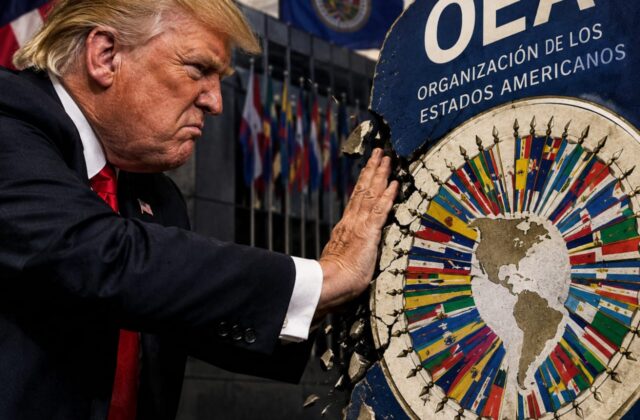
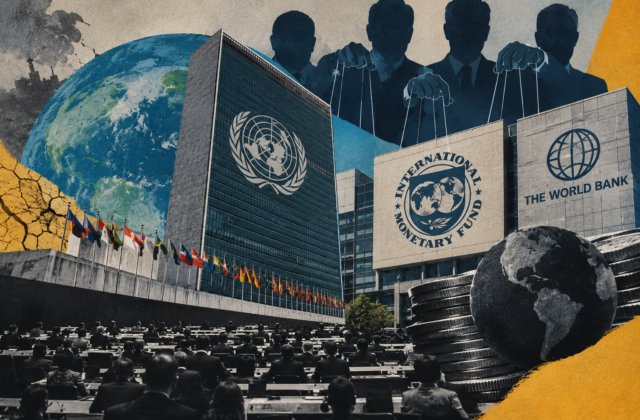
Likewise, President Trump has continued the process of dismantling the institutions and world order created after World War II, based on international law established in the United Nations Charter and the Bretton Woods institutions. As China consolidates its technological, productive, and naval power, the United States is betting on force and refusing to accept a democratic reform of these institutions, as proposed by Russia, China, and the BRICS countries. Trump plans to dismantle them and return to gunboat diplomacy.

On Thursday, Trump withdrew from 66 international organizations, 31 of which belong to the United Nations, linked in particular to climate change, food, children, and culture, among others.

But weapons are not everything. The economy does not bode well. A chronic fiscal deficit exceeding 6% of GDP, a snowballing debt of $38 trillion that is undermining the confidence of dollar and Treasury bond holders, and, more seriously, the loss of value of the dollar against a basket of the world’s major currencies, and its vulnerability as a reserve currency and means of payment add up to problems for the U.S. economy. Trump urgently needs oil to continue to be sold in dollars and not in local currencies in order to maintain his hegemonic role.

Morale is not good either. The president needs to generate events that divert attention from the thousands of files in the Epstein case that have not yet been disclosed, in which he is involved.

Trump has managed to subdue Chavez followers in Venezuela for now. Both governments are exploring the resumption of diplomatic relations, and Venezuela has released political prisoners, a process that Maduro had begun days earlier and which was one of the Achilles’ heels of the Bolivarian process.

The U.S. government’s demands on Venezuela regarding the management of its economy and access to its natural resources will generate serious tensions. The rest of the region will have less sovereignty in its relations with other powers. U.S. authorities have said in every language that we are their hemisphere. Only an agenda with minimum common standards of dignity can mitigate Trump’s arrogance in dominating our region.


“The World in Focus” is Ariela Ruiz Caro’s biweekly column for Mira: Feminisms and Democracies. Ariela Ruiz Caro is an economist with a master’s degree in economic integration processes and an international consultant on trade, integration, and natural resources at ECLAC, the Latin American Economic System (SELA), and the Institute for the Integration of Latin America and the Caribbean (INTAL), among others. She has been an official of the Andean Community, an advisor to the Commission of Permanent Representatives of MERCOSUR, and Economic Attaché at the Peruvian Embassy in Argentina.

FEATURED

Decolonialismo

Trump’s Imperialism Revival

After a 100 years out of favour, imperialism is back. A century ago, my own nation, Ireland, managed to wade