 By Martha Pskowski and Alex Mensing
“Nosotros decidimos entre todos hacer una caminata hasta Palenque.”/“All of us, together, have decided to walk to Palenque.”
Eighty kilometers separate Tenosique, Tabasco, from Palenque, Chiapas. By the end, the walk that started in Tenosique ended up all the way in Reynosa, Tamaulipas, on the border with the United States.
This is the story of that walk and the people who decided to take it.
Without papers or protection, Central Americans migrating through Mexico must evade detection by Mexican immigration officials who may detain and deport them, state and federal police who commonly subject them to extortion, and organized crime on the local, national and transnational levels who have made them a prime target for robbery, kidnapping and murder. So it is no surprise that the issue of Central American migration through Mexico remains invisible to most Mexicans. They have to be invisible to survive.
But in the Mexican states of Tabasco, Chiapas and Veracruz, the dangers being invisibile are becoming even greater than the risks of being seen by the law.
Boarding the train in Tabasco and southern Veracruz has become a matter of life and death. By February of this year, every week or two news articles reported on migrants killed for not paying the “quota.” The maras – the Central American gangs who terrorize migrants throughout the country – demand that migrants hopping the train pay $100 each.
The largest of these gangs, the Mara Salvatrucha 13 and Barrio 18, have created alliances with the Zetas and the Gulf cartels that operate along the migrant routes. The cartels have bought off local police agents and Immigration officials in many places, allowing their drug trafficking, kidnapping and extortions operations to continue without prosecution.
In recent weeks, the freight train operators stopped letting migrants board “La Bestia,” the cargo train they ride to the center of the country. While the train is dangerous, being abandoned along the route left many as sitting ducks.
On March 31, Veracruz Gov. Javier Duarte brought a lawsuit to the Attorney General against the train companies Ferrocarriles Sur and Kansas City Group, arguing that they are responsible for the murders, injuries and extortions that migrants face when they hop the train. Duarte argued that the case would compel the companies to address the problems aboard the trains.
But critics such as Rubén Figueroa of the Mesoamerican Migration Movement (MMM) say the case only makes migrants more vulnerable and does nothing to solve the problems. Without any other option, in early April hundreds of migrants began to gather in Tenosique, having heard about the “Viacrucis del Migrante,” which they hoped would help them make the first leg of their journey safely.
The Viacrucis, Organizing to Protect Migrants in Mexico
In Tenosique, a few days’ walk from the border with Guatemala, Friar Tomás and the MMM were poised to launch their fourth Viacrucis to draw attention to the migrant journey through southern Mexico and call for free transit for migrants. In English, the Viacrucis translates to “Stations of the Cross,” or the stages Christ passed through carrying his cross to his crucifixion. It is traditional in Catholic churches to re-enact the Viacrucis during Lent, reminding the faithful of Christ’s suffering.
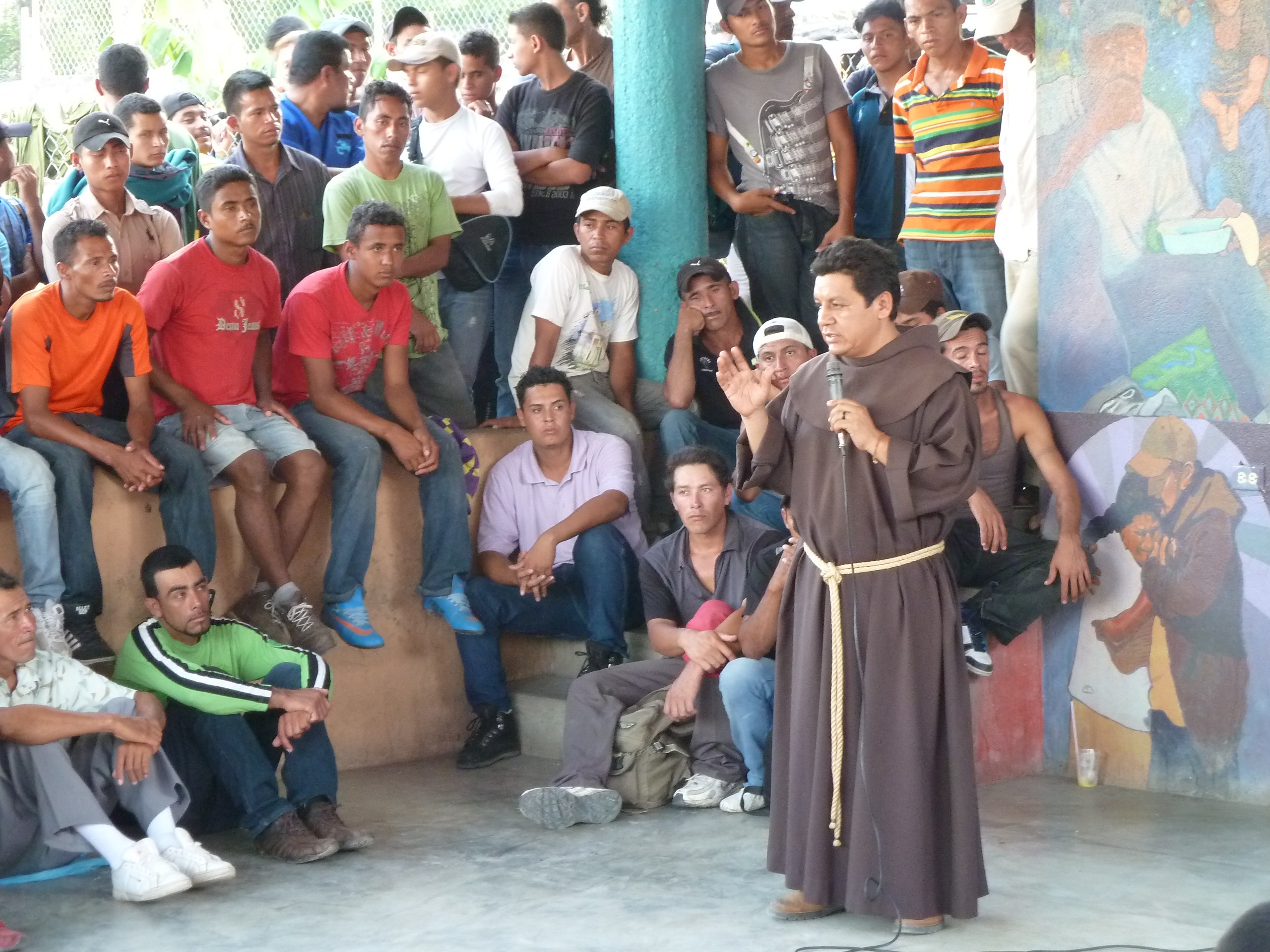
Friar Tomás is the Dominican priest who runs the migrant shelter in Tenosique, Tabasco, “La 72”, named to commemorate the 72 migrants who were found massacred by the Zetas in Tamaulipas. Friar Tomás, “La 72,” and the MMM had been preparing for the Viacrucis and spreading the word among migrants. The plan was to board the cargo train “La Bestia” and ride it to its first stop in Palenque, Chiapas.
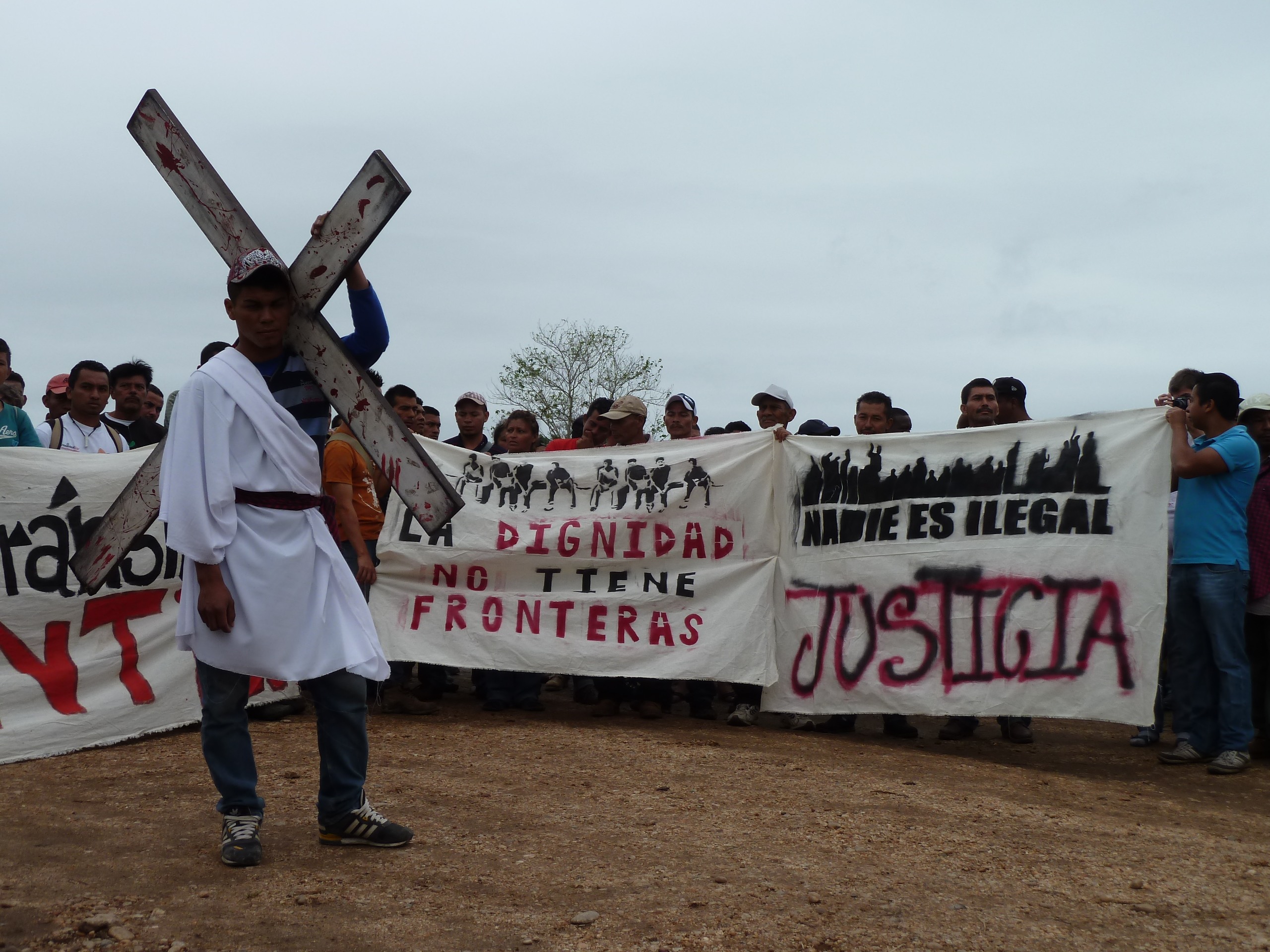 The Viacrucis drew inspiration from previous caravans for migrants’ rights and protection. The ninth Caravan of Central American Mothers in Search of their Disappeared Children criss-crossed Mexico in November and December 2013, and a group of Honduran amputees who lost limbs on the train ride held a caravan in April of 2014. The MMM organizes the Mother’s Caravan that helped re-unite 12 migrants with family members in 2013 alone.
The fourth caravan of amputees this spring was organized by the Association of Returned Migrants with Disabilities (AMIREDIS). Sixteen Honduran men between the ages of 29 and 50 journeyed from the border to Mexico City, seeking an audience with President Enrique Peña Nieto. He refused to meet with them, yet all along their journey they gained media attention and increased public awareness of the deadly dangers migrants face in Mexico.
In Tenosique, Augusto was one of those waiting for the departure of the Viacrucis. Describing the situation in his home country of Honduras, Augusto explained that, “to live you have to pay the impuesto de guerra [war tax]. Just like how on this journey they’re charging us a fee to be able to board La Bestia, the train, it’s like that in Honduras too. To be able to live in your house you have to pay, too. In your own house. If not, well, they mess up your family, they kill them. We’re screwed there.”[1]
Augusto is a welder with a wife, two kids, a mother and several brothers who depend on him. He is keenly aware of the dangers of the journey through Mexico.
“Imagine,” he says. “If they depend on you and you come here and lose your life, then who is going to feed your family?”[2]
Days earlier, a Salvadoran migrant who left his family behind was shot dead for not paying the organized crime bands who charge migrants to get on the train.
The Viacrucis caravan planned to include the press and human rights defenders, bringing public attention to the need to protect migrants on their journey. Augusto and his friends waiting to join the Viacrucis hoped that by participating the migrants could help themselves, each other and those who have yet to begin the journey.
As Friar Tomás said later on, “We are making visible what for many years has been invisible … the death that our governments cause us, the economic system, which is the most responsible for forcing us to leave, which gives us death. We cannot continue to die. We have to transform this pathway of death into a pathway of life.”[3]
‘Vamos caminando’ – The Viacrucis Begins
On April 14, the MMM and La 72 shelter published a communiqué with the demands of the Viacrucis. Alongside the primary demand of free transit for migrants, the publication called for the “dissolution of the National Immigration Institute and the creation of an Institute that promotes human security instead of national security,” the creation of public policy at a regional level to end forced migration and structural violence, and for Mexico to offer asylum and refuge to those fleeing violence in their countries.
The journey began in Guatemala on April 15 with Friar Tomás and Rubén Figueroa, spokesperson of the MMM, as the leading civil society members of the caravan on the route from the border to Tenosique. This first leg traveled upriver by boat or raft from El Naranjo, Guatemala, to a ranch near the Mexican border. While waiting for the second boatman to reach the ranch with the rest of the group, the first boatman described his experiences.
“It’s a tough journey,” he remarked solemnly. “I wouldn’t know to say [how many], but tons of them pass through.”[4]
He remembered how they used to take groups of migrants right by the nearby military outpost, bribing the officers with “women, food and tequila.” The guards have since been changed, though, and now they have to circumvent the outpost. Some of the guides who operate in the area charge high fees and leave migrants stranded. Some of them charge less and are more honest. Either way, all of them take advantage of the business opportunity of carrying human cargo.
From the ranch, the group walked to a town called El Pedregal, crossing the border along the way. Most migrants then walk a night or two to Tenosique, where they arrive with blisters and sores on their feet. The Viacrucis traveled to Tenosique by pickup truck, accompanied by a group of migrants who arrived in El Pedregal around the same time. At first they were wary of the journalists and activists – after all, as many migrants say, during this journey “you should trust no one, not even your shadow.” But a few of them had heard about the Viacrucis back in Guatemala, and they were glad to join, grinning widely as the pickup driven by Friar Tomás passed unhindered through immigration checkpoints along the way.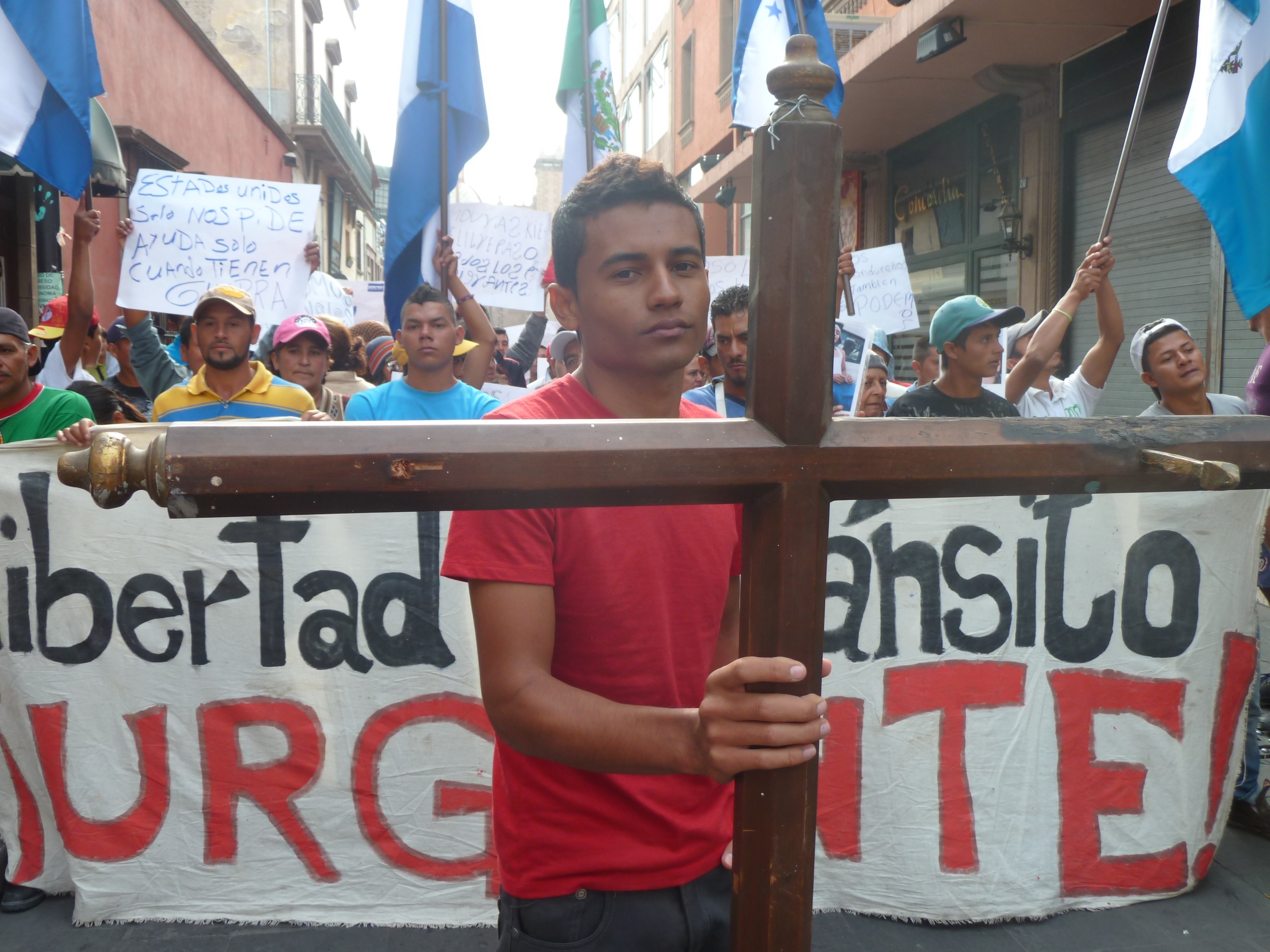
The following day, leaders of the shelter and migrants marched through Tenosique to the migration checkpoint on the highway, where they rallied outside with music, speeches and chants. Such activities, as Friar Tomás and Rubén Figueroa know well, serve not only to draw attention, but also to build a sense of community and social struggle among the group of migrants participating in the Viacrucis.
At the rally, Friar Tomás stressed the non-violent nature of the caravan and called for unity. He repeated a message from earlier talks with the migrants, “If we don’t transform our indignation, our anger, into a pathway of life, we won’t ever achieve much.”[5]
Friar Tomás also spoke of the dangers of organized crime during the journey but assured the group that, “One criminal can’t accomplish more than hundreds of people filled with hope.”[6]
He recounted the Viacrucis’ demands and critiques and condemned both Mexico’s and the United States’ immigration policies as designed “to control and to stop, dictated by the migratory policy of the United States of North America. The migratory policy of that country is designed to kill.”[7]
The migrants took turns at the microphone, declaring that they, too, are human beings. “Nobody is illegal,” cried a Honduran man. “We’re all legal on Earth. The earth isn’t just the United States. We can go where we want.”[8]
Back in the shelter amid music and jokes the wait for the train began. A Honduran migrant known as “Treinta Treinta,” or “Thirty Thirty,” eased the tension with his sense of humor and raspy voice, as the migrants pressed around him howled at another of his classic jokes. People gathered around guitar-player Erick, also from Honduras, who plays in a band in New Orleans where he has lived for years. He was deported recently after being caught without papers and his family is waiting anxiously for him to return.
It wasn’t until the early hours of the next morning that the train could be heard rumbling in the distance. Nearly 500 members of the caravan boarded the train, squeezing onto just a few cars.
They waited for over four hours atop the train for it to pull out, listening intently for the clang, clang, clang that announces the jerking of the cars as they jolt forward one by one. If you don’t hold on tight, you can end up like so many migrants, missing a hand, a limb, or worse. In the first light of morning, the train finally began to move. It pulled out of Tenosique – but it left the migrants behind.
The operators had detached the cars that carried the migrants. They informed Friar Tomás that they were acting on “orders from the company.”
Back in the shelter, many expressed frustration, confusion and anger. Friar Tomás assembled everyone and addressed the migrants. “What are we going to do? This is what you all have to decide … This is the moment when you all have to take seriously the defense of your rights.”[9]
Figueroa, who migrated to work in North Carolina and returned to Mexico to join the struggle to defend migrants’ rights, addressed the group of worried migrants. “Now we have to do this work collectively. Today it is you all who are going to take the lead.”[10]
Around 450 migrants discussed their options, considering that the next train to Palenque might or might not let them board. Wiliam, a Honduran, announced the group’s decision:
“All of us have decided together that we’re going to walk to Palenque.”
Immediately the shelter began to buzz with excitement and activity. The migrants organized teams to go out into the neighborhoods of Tenosique to ask for donations to support their march to Palenque. Another team got to work on cleaning the shelter. The activists and human rights defenders, began writing a communiqué to be published by the MMM:
“We’re not looking just to board the train, on the contrary, we demand the right to cross safely and freely, without being subject to extortion and violence on the part of the authorities and organized crime.”[11]
At that moment, the 2014 Viacrucis took a decidedly different turn from previous caravans. It was not just a symbolic action to call attention to the plight of migrants. It had become the most basic challenge migrants face – figuring out how to journey north when all your plans fall through. But this time, they did it together and, along the way, they were demanding a path free of violence and humiliation for all migrants.
It wasn’t an easy decision for everyone to make. Migrants had to weigh between participating in the struggle for migrants’ rights and their need to provide for their families. One migrant expressed his hesitation, insisting that he wanted to help the movement, but he was uncertain of how long the walk would take and he was in a hurry to journey north and send money home.
But the previous days of assemblies, sign-making, marching, praying and singing had instilled a sense of community and collective spirit that would not be broken easily. Most of the migrants decided to join the caravan.
Tabasco, Chiapas, Veracruz and Puebla
The group left Tenosique on April 17 at 5 pm, walking toward Palenque long into the night until they reached a small town, Arena de Hidalgo. When they got there, volunteers set out to look for the town officials to announce their arrival. Over the megaphone Friar Tomás explained, “We have to tell them that we won’t do any harm, that we aren’t criminals, that we’ve decided to walk because the train didn’t allow us to board.”[12]
Within an hour, the town opened the town park’s bathrooms to the migrants, provided them with water, and donated snacks to feed the hungry men, women and children after more than 20 kilometers of walking. Exhausted and with blistered feet, the migrants lay down to rest for the night.
The next morning, as migrants talked about the delicious tamales donated for breakfast, Aaron Rodríguez, executive director of the Scalabrinians Mission for Migrants and Refugees, reflected, “This is tremendous solidarity. Where do you see this?”[13] That solidarity didn’t end in Arena de Hidalgo.
When energy and morale began to wane in the heat of the day, the migrant group came across a small church in the countryside whose members had gathered to celebrate Good Friday with candied squash and pozol – a corn-based drink. They donated all they had to the migrants of the Viacrucis.
“There wasn’t enough for everyone,” remarked one churchgoer, “because it was just going to be for us. But we offered them something at least.”
Members of the Catholic church from the next city along the way arrived to shuttle the migrants of the Viacrucis onward in their pickup trucks. Friar Aurelio of the migrant shelter “La 72” and Sister Magdalena of Cafemin traveled ahead of the group to notify towns of their arrival and request support.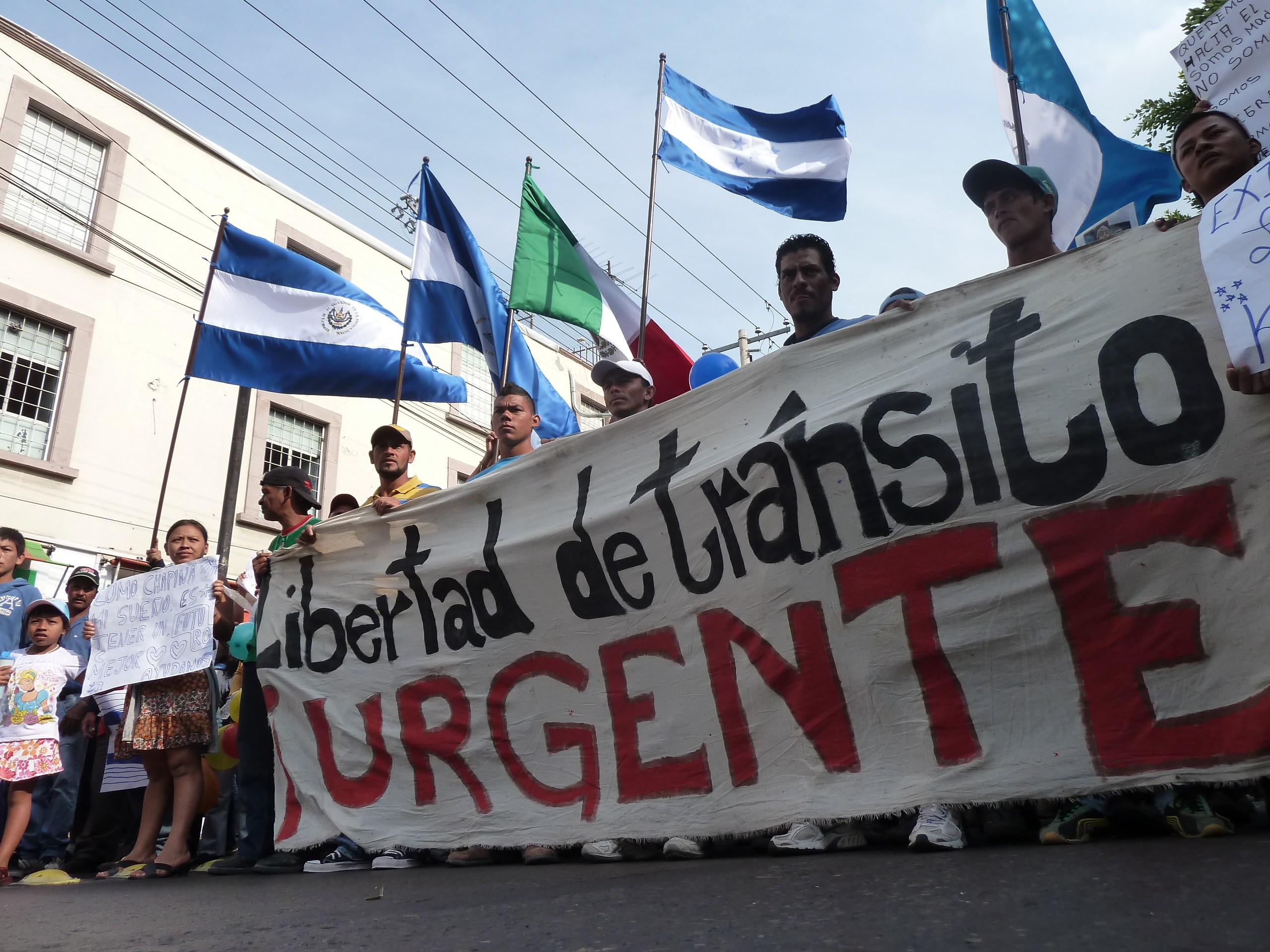
When the group reached the town of Playas de Catazaja, they were met by more than 200 migrants who had traveled from the shelter in Palenque to join the Viacrucis. They left Palenque on foot but managed to convince the state to provide transportation and arrived in Military Police trucks.
With a larger group and a sense of momentum, the migrant group decided to bypass Palenque and go directly toward Veracruz.
The Gulf Coast state of Veracruz stretches from the south up to the center of Mexico. From Guatemala, migrants choose to travel via Ixtepec, Oaxaca, or Tenosique, Tabasco, but all who ride “La Bestia” must pass through Veracruz to board trains in the State of Mexico. Veracruz has been one of the most dangerous places for migrants in recent years and recent months have seen a spate of migrant deaths.
The Viacrusis stopped first in the city of Coatzacoalcos, Veracruz. “Coatza,” as many call it, features prominently in the horror stories that migrants share with each other and with journalists, especially when it comes to organized crime and kidnappings. They often speak generally about what happens along the train tracks. Only when asked directly do they say, quietly and with sidelong glances, that they are the person from their story who was kidnapped, who was robbed, who was raped. They show the scars and laugh.
Everyone hears about the risks before they leave home. “But what else can we do?” they ask. “We have no choice.” They have to feed their families, or they are fleeing death threats from the gangs.
The migrants left the buses at the edge of town and entered the city on foot, marching 700 strong to an overpass by the train tracks where a local charity organization distributes free meals to migrants. There a busload of nearly 100 migrants from the Hermanos en el Camino shelter in Ixtepec, Oaxaca, joined the caravan, accompanied by the shelter’s founder Father Alejandro Solalinde.
By this point, the Viacrucis had gained press attention and the respect of Mexican citizens. The participants no longer had to walk along the highway, hoping for donations of food and water from passers-by. They used their political capital to secure buses, meals and medical services from state and regional governments and local organizations.
Now four days into the journey, the Viacrucis’ organizational structure had also developed significantly. The migrants held meetings to form a team of coordinators representing groups formed for Honduras, El Salvador, Guatemala, Nicaragua, women, Garifunas (an afro-descendent population from Honduras) and the LGBTQIA community. The representatives met regularly with activists and human rights defenders who were accompanying the Viacrucis, and participated actively in leading public actions, making group decisions and speaking with the press.
Elena Urbina, a representative of the women’s group traveling with her husband and two children, explained that she decided to join the Viacrucis for the protection it offered. But from early on, even before being chosen as a representative, she felt a growing sense of pride and excitement in what the Viacrucis represented as a social movement.
“For me, [the caravan] is going to be something historic,” she said on the second day of walking. “It will go down in history because it’s something that I have faith that we will achieve all together.”[14]
Arriving in Amatlán de los Reyes, Veracruz, the migrant representatives and human rights defenders accompanying the Viacrucis met with Gov. Duarte. They returned to the group with the good news that the governor had promised to establish free transit of migrants in the state and that the Viacrucis would be transported by bus. They also returned to a delicious meal of chicken, rice, beans and tortillas prepared by Las Patronas, a group of women who have been giving food to migrants for years. They take pride in the meals they serve to those who pass by their village on “La Bestia,” and the dinner they prepared for the Viacrucis was no exception.
After a night in Puebla, where migrants had a chance to rest and relax because the scheduled march was cancelled due to rain, the Viacrucis continued on to Mexico City. On April 23, six days after the original group of 450 left Tenosique on foot, well over 1,000 undocumented Central American migrants entered Mexico’s capital.
Mexico City: Those Who Grant Papers and Those Without Them
Mexico City represented a climax of sorts for the Viacrucis. The group left over 20 buses behind at the Angel of Independence and marched to the presidential residence at Los Pinos, chanting along the way: “¡Los migrantes no somos criminales! ¡Somos trabajadores internacionales!” (“We migrants aren’t criminals! We’re international workers!”) The moral authority of the Viacrucis was demonstrated by the conspicuous absence of riot police, almost always present when more than a few hundred people demonstrate on the major streets of Mexico City.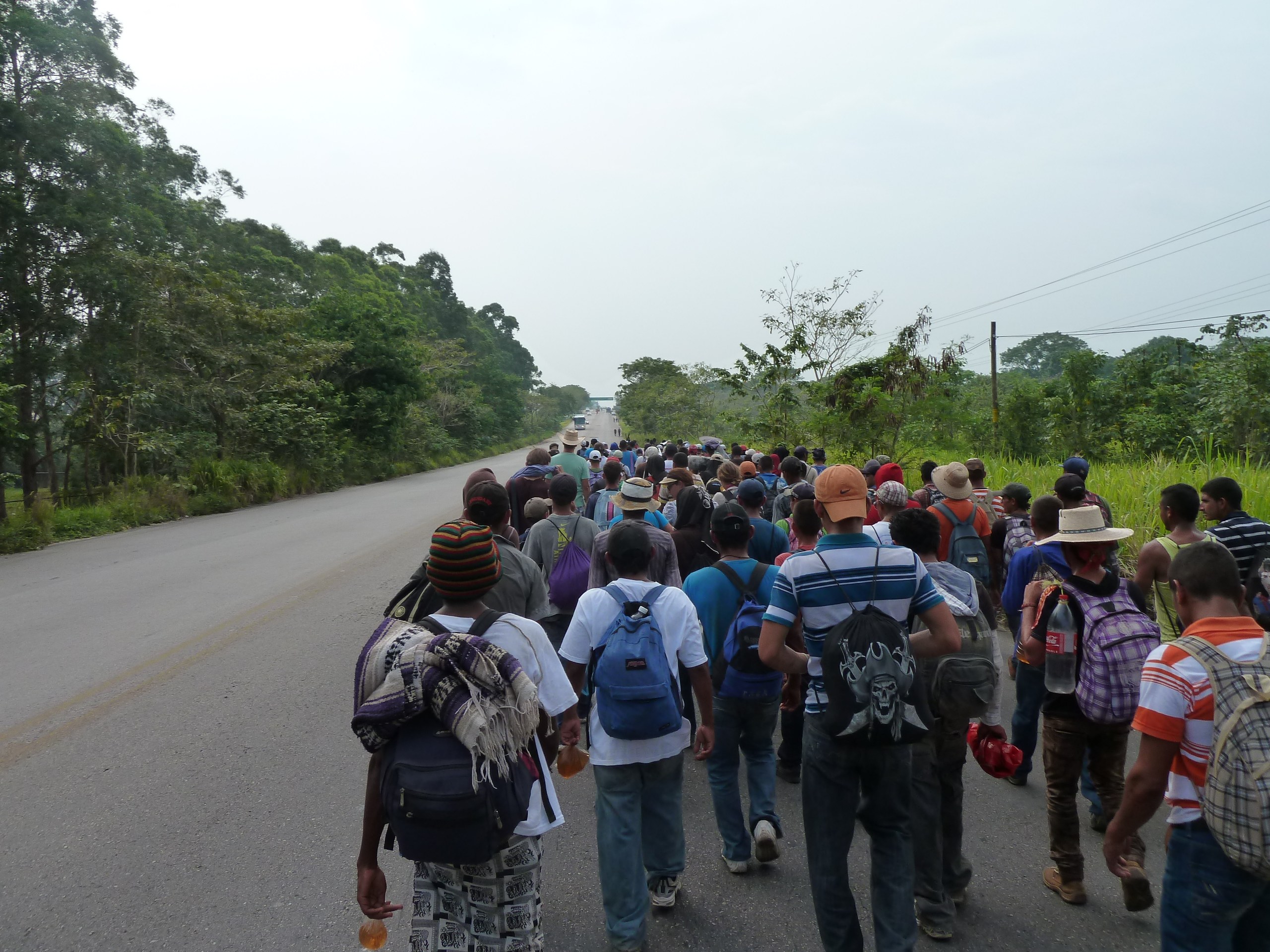
Many long-time defenders of migrant rights spoke to the press alongside the migrants at the entrance to the presidential residence, including Friar Tomás, Rubén Figueroa and Marta Sánchez Soler of the MMM, Sister Leticia Gutiérrez and Aaron Rodríguez of the Scalabriniana order, Father Solalinde and others. In many cases throughout the journey to Mexico City, the Viacrucis had secured transportation or lodging thanks to a combination of the connections provided by the migrant rights defenders, formed through years of hard work, negotiating and advocacy, and the political pressure of hundreds of migrants marching for their rights.
Now in the capital, that combination of long-term working relationships and massive political defiance allowed the Viacrucis to arrange meetings with members of the executive and the legislative branches of the federal government. At a meeting with officials including Paloma Guillén, Under Secretary for Migration and Religious Issues, and Ardelio Vargas, director of the Mexican Migration Institute (similar to ICE in the US), the commission of migrant representatives and the human rights defenders who accompanied them negotiated the issuing of 30-day “exit permits” to all members of the Viacrucis. The permits allow their holder to travel freely and legally in Mexico for up to 30 days, after which they must have left the country.
_________________________________________________________________________________________________
“[We are doing this] not just for ourselves, but for all of those who come after us, and for all the blood spilt on the railways. It is a shame that Mexico knows about it, but looks the other way.”
__________________________________________________________________________________________________
On April 24, around 40 migrants accompanied by several of the migrant rights defenders met with a group of national legislators to tell their stories and assert their demands. Axel, the migrant representative from Guatemala, told those assembled, “I fled here because if I didn’t pay an extortion there, they would kill me … [we are doing this] not just for ourselves, but for all of those who come after us, and for all the blood spilt on the railways. It is a shame that Mexico knows about it, but looks the other way.”[15]
Guatemalan migrant Jessica Paola Sánchez López provided her personal testimony of the suffering that many Central Americans, especially women, face in their home countries and along the migrant route:
“I have a little girl … One night before arriving at the migrant shelter [in Tenosique] we slept in a truck, in the cold. Begging for food. So my daughter, she was the one who suffered most, she said to me, ‘Mommy, where are we going?’ And I told her, ‘To look for a better future.’ Because I don’t have family ahead or behind in my country. They mocked me there because I am a single mother. My family kicked me out of the house. So many things have happened to me. If I keep going forward and cross the border, God willing, I don’t have anybody waiting for me there … And if I go back to my country, perhaps I’ll suffer even more.”[16]
Delia María Baraona from Honduras voiced the migrants’ demand that Mexico allow migrants to travel freely and securely through the country:
“It’s clear that we watch the news and we see all of the cases that come up on a daily basis. We’ve seen everything that happens on the train … Many of us leave our countries, as the others mentioned, with the idea of finding a new opportunity, somewhere we can get ahead, because we aren’t bad people … So we just ask that you give us a transit visa and that there be an urgent restructuring of the department of migration because they commit extortion against us.”[17]
The lawmakers listened to testimony after testimony, recounting the reality of forced migration and structural violence. And yet, as Marta Sanchez Soler pointed out during the meeting, this was not the first time that Central American migrants have met with legislators. And the problem not only remains, but it is growing. Sanchez Soler urged those present to make good on their promises to improve legislation and regulation, warning that the situation is becoming a crisis.
They won their transit visas. Promises and permits in hand, many of the migrants still had their sights set on the northern border.
Mexico City was the last stop for some of the migrant rights defenders. It was time for them to return to their respective homes and get back to work with the daily labor of running shelters, kitchens, offices and organizations. Those who left continued to support from afar, and some carried on with the Viacrucis.
In the North there were other human rights defenders and shelters ready to recieve and accompany the migrants, many of whom were as anxious to keep moving as they were excited about the success of the Viacrucis‘ activities in Mexico City. From then on, however, the participation of migrant representatives in coordinating decisions, organization and logistics became even more important.
To the Río Bravo, and Beyond
The government of the State of Mexico, bordering the Federal District, has been notoriously unfriendly to migrants. Several shelters have been forced to close in recent years and humanitarian organizations struggle to keep services available to migrants. After spending the night of April 25 in Lechería under conditions much worse than promised by the state government, the 700-800 migrants who continued with the Viacrucis marched to Huehuetoca where they were recieved by the state-run shelter San Juan Diego Cuauhtlatoatzin.
The phone calls, communiqués and mere presence of hundreds of migrants that had helped to secure transportation for the Viacrucis in other states proved insufficient in the State of Mexico. It was not until migrant representatives and accompanying activists decided to announce, on April 28, their plan to take to the highway on foot the next morning at 4 am that buses were provided to take the migrant group to San Luis Potosí.
Migrant representatives like Jaime Henríquez of Honduras helped keep the flow of information open between organizers and migrants, and were increasingly important in managing logistics such as registering members of the Viacrucis and coordinating the loading and unloading of buses. Henríquez has traveled the trains many times, knows the migrant journey well, and has himself been the target of kidnappings and assault. Broad-shouldered and stocky, when he talks about the threats he’s recieved he always adds that he’s not afraid of anything.
Migrants who had been previously less involved with the many tasks involved in running the Viacrucis began to take on more active roles. A young Honduran migrant, nicknamed “El Chele” – the word for a light-skinned person in Honduras, found his niche in the kitchen at the shelter in Huehuetoca. Previously “El Chele” had frustrated coordinators with his reluctancy to cooperate, but when asked about his participation in the kitchen he responded, “After seeing how many of the migrants and those who accompany us work all the time for the Viacrucis, I began to think, why don’t I help out, too?”
The Viacrucis was well received in San Luis Potosí at the shelter run by Father Rubén Pérez Ortiz, who helped organize a press conference following a march through the city’s Historic Center. The task of speaking with the media fell on the shoulders of the representatives from each sector of the migrant population. In Saltillo, Father Pedro Pantoja, Bishop Raúl Vera and several activists accompanied a commission of migrants to a meeting with the governor of the state of Coahuila. The commission included a woman known endearingly by all in the Viacrucis as “la abuelita,” or “the grandmother.”
La abuelita’s real name is Blanca Lidia Valenzuela. Honduran, she has traveled to Mexico 16 times in the past nine years to search for her disappeared son, Víctor Manuel Hernandez. Valenzuela’s earth-colored face is wrinkled with age and when she talks about her son it betrays a heavy tiredness. But the same face has wrinkles that deepen when she smiles, and she showed she was not only determined to find her son, but she was also determined to accompany the Viacrucis until the end and speak her mind.
From Saltillo half of the group went to the border town of Reynosa, Tamaulipas, making the Viacrucis the first caravan of hundreds of migrants to travel the entire length of Mexico. The other half went to Monterrey, where migrants could choose to stay and work or travel to other border towns. La abuelita became one of 60 of the most vulnerable migrants – women, children, unaccompanied minors and members of the GLBTQIA community – who decided to turn themselves in together to U.S. immigration authorities to apply for political asylum on May 3.
The previous day, the approximately 200 migrants who remained in the migrant shelter in Reynosa had performed a final act of protest by marching to the bank of the Río Bravo and forming the number 72 with their bodies lying still on the ground. A group of migrants had painted letters on their chests in red paint to spell out the question “Where are the guilty ones?” The act commemorated the massacre of the 72 migrants in nearby San Fernando and asked a simple question, a question that criticizes the impunity that reigns along the entire migratory route in Mexico, an impunity symbolized by the 72 migrants of San Fernando. The same 72 for which the migrant shelter “La 72” is named, the shelter where the Viacrucis began.
End of the Road, Beginning of the Next
After the protest in Reynosa, the migrants engaged in one last moment of political defiance. Coordinators began to call for the migrants to begin marching back to the shelter, but instead they began to gather on an outcrop overlooking the river.
They gathered around a cross dedicated to those who have died attempting to cross to the other side. On the other side, within a stone’s throw, horse-mounted U.S. Border Patrol agents had gathered, probably in anticipation of the event, which had been publicized.
The migrants stood together overlooking the river that separates Mexico from the United States, Latin America from so-called “America,” poor from rich, them from their dreams and goals. The migrants began to chant. Loudly, emphatically, perhaps angrily.
¡Libertad, libertad, al migrante libertad! Liberty, liberty, for the migrant liberty!
This outburst – alarming to the director of the migrant shelter, who was worried about security and the U.S. Border Patrol helicopter flying low above the demonstration showed that this group of migrants had stepped definitively out of the shadows in which so many Central Americans struggle, hide, suffer and die. They were no longer afraid, and they were no longer silent.
It also showed that although they viewed the United States as their perceived source of economic opportunity, security and hope, the migrants clearly denounced the U.S. role in regional migration.
U.S. immigration policy, as well as its foreign policy and economic system, has moved much of Central America toward greater violence, poverty and instability. These conditions lead to forced migration, where people then face the structural violence and criminalization that result from Mexican immigration policy.
The migrants looked across the river and could see the mounted border patrol. The knew the poker-faced guards could hear them, and they expressed their indignation, loud and clear, together.
Martha Pskowski is a writer and researcher based in Mexico City, originally from the Washington, DC area. Martha holds a B.A. from Hampshire College and works in the fields of anthropology and geography. Her research focuses on global environmental politics and their impacts on the indigenous communities of Mexico and Central American migrants in Mexico. She is a member of the CIP Americas Program team at www.americas.org. Alex Mensing is an independent writer, traveler organizer from the Western US.
NOTES:
[1]uno para poder vivir tiene que pagar un impuesto de guerra. O sea, como que ahorita venimos en este camino y ahí nos están cobrando una cuota para podernos montar a la bestia, que es el tren, así es en Honduras también. Para que puedas vivir en tu casa tienes que pagar también. En la casa de uno. Si no, pues, ya les chingan la familia a uno, pues, las matan y estamos fregados allá. Usted sabe que la familia es primero, pues.
[2]Imagínate, si ellos dependen de tí, y tú vienes a perder la vida aquí, ¿entonces quién va a alimentar a tu familia?
[3] “Aquí tenemos que empezar a transformar el camino de dolor. La muerte que nos infunden nuestros gobiernos, el sistema económico que es el más culpable por el que estamos saliendo, que nos da muerte, nosotros no podemos seguir muriendo. Tenemos que transformar este camino de muerte en camino de vida.”
[4] “Está duro el camino.” “No sabría decirte [cuantos], pero sí pasan muchísimos.”
[5]“si nuestra indignación, nuestro coraje, no lo transformamos en un camino de vida, poco es lo que vamos a lograr.”
[6]No puede hacer más un criminal que tres cientos personas llenas de esperanza.
[7]“controlar y para frenar, dictada por la política migratoria de los Estados Unidos de Norteamérica. Aquella política migratoria de ese país está diseñada para matar.
[8]“Que nadie es ilegal. Que todos somos legales en la tierra. Que la tierra no sólo es Estados Unidos. Que podemos ir aquí donde nosotros queramos.”
[9] Que vamos a hacer? Eso es lo que ustedes se tienen que poner de acuerdo, verdad?
Eso es el momento en que ustedes tomen en serio la defensa sus proprios derechos
[10]Ahora el trabajo lo podemos hacer en común. Hoy día ustedes son los que van a lanzar la voz.
[11] No se busca el simple abordaje del tren, por el contrario, se exige el derecho a cruzar el
país de manera segura y libre, sin estar expuestos a la extorsión y a la violencia por
parte de las autoridades y del Crimen Organizado.
[12]Decirles quienes somos y qué estamos haciendo. Decirles que no vamos a hacer ningún daño, que no somos delincuentes, que hemos decidido caminar porque el tren no nos dejó subir.
[13]Esta es una solidaridad tremenda. ¿Dónde lo ves esto?
[14]Elena Urbida, in Interview with the authors DATE/PLACE
[15]“Yo me vine huyendo de allá porque si no pagaba una extorsión, me mataban. […] Todo esto que estamos haciendo, no sólo por nosotros, sino que por todos los otros que vienen detrás de nosotros, y por toda esa sangre derramada en las líneas del tren, que lastimosamente el pueblo de México lo sabe, pero se hace de la vista gorda.”
[16] “Yo tengo una niña pequeña. …Una noche antes de llegar al albergue nosotros durmimos en un camión, aguantando frío. Pidiendo comida. Entonces mi hija es así. Ella fue la que sufrió más. Ella me decía “mamita donde vamos.” Y yo le decía a ella “a buscar un mejor futuro.” Porque yo no tengo familia ni adelante ni yendo para atrás a mi país. Entonces allá muchos se burlan porque yo soy madre soltera. Mi familia me echó de la casa. A mí me han ocurrido muchas cosas. Si yo me voy para adelante, cruzo la frontera, que primero diós sea así, yo no tengo a ninguna persona que me está esperando allá. … Y si me regresan para atrás, quizá voy a sufrir mucho más.”
[17] “Es obvio que vemos las noticias y vemos los casos que se presentan a diario. Hemos visto todo lo que pasa en el tren. … Porque muchos salimos de nuestros paises como lo mencionaban los compañeros con una ilusión de encontrar una nueva oportunidad, donde salir adelante porque no somos personas malas. …Entonces sí pedimos que nos den una visa de tránsito y una urgente reingienería en el departamento de migración porque ellos nos extorsionan.”