The World in Focus
While far-right candidate Rafael López Aliaga of Renovación Popular is running out of ammunition to delegitimize the results of the April 12 election, the winner of the first round, Keiko Fujimori, is preparing to face Roberto Sánchez, the heir apparent to Pedro Castillo, on June 7. The vote margin in favor of Sánchez has increased and now exceeds 20,000. The vote count has concluded, and only the contested ballots before the Special Electoral Tribunal remain to be tallied. The statistics show that, legally and mathematically, there is no chance of reversing the result.
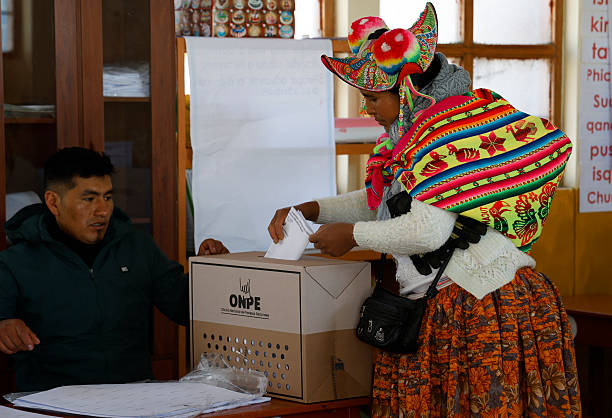
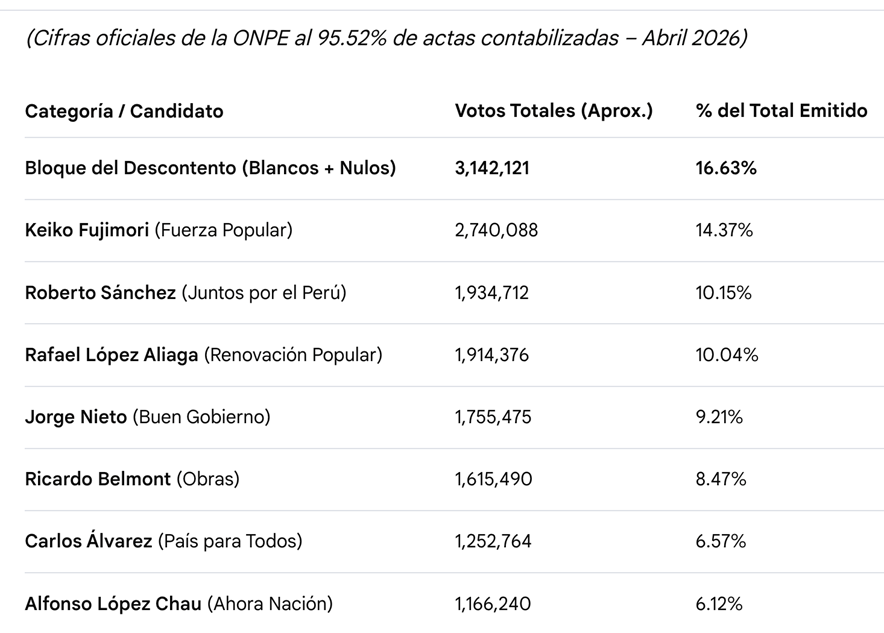
With the count practically complete, the reality shows that Peruvians have chosen silence and a rejection of democratic institutions. Figures from the National Office of Electoral Processes (ONPE) clearly reveal that, out of a total of 27.3 million registered voters, the most significant factor in the election is a bloc of 11.4 million who did not vote for anyone, represented by abstentions and invalid and blank ballots. These account for 42% of the voter registry, and their votes exceed those received by the top-voted candidate by more than four times. Abstention is the leading electoral force in a fragmented nation that, at its most critical hour, has preferred a vacuum over the options on display.
As if the crisis surrounding the electoral process—fueled by the far-right López Aliaga—weren’t enough, this week brought the possibility of a new presidential vacancy, the ninth in ten years. The current president, José María Balcázar, who has been in office for three months, announced that a transitional government, such as the one he heads, should not commit to such large sums ($3.5 billion) for the purchase of 24 F-16 Block 70 fighter jets and a Boeing KC-135 R Stratotanker refueling aircraft from the U.S. company Lockheed Martin, and that the decision should be left to the president elected on June 7. He added that there were more pressing needs than allocating those funds to the purchase of fighter jets.
The problem is that his predecessor, former President José Jerí, had already signed the commercial agreement with Lockheed Martin, and the payment deadlines were approaching. This contradiction between the signing of the contract with Lockheed Martin and President Balcázar’s statements triggered the resignation of his defense and foreign affairs ministers and the initiation of a new motion of no confidence on grounds of moral incapacity, which is currently underway.
The Weapons of Chaos
As the vote count favors Roberto Sánchez, Minister of Foreign Trade during Pedro Castillo’s administration, Rafael López Aliaga’s aggressiveness increases, but it collides with reality. The ultimatum that the far-right candidate issued to the president of the National Elections Board (JNE), Roberto Burneo, to annul the electoral process under the threat of civil insurgency—a provision provided for in the Constitution, but inapplicable in this case—and that if he did not declare the election null and void, he would unleash his entire “Plan Morrocoy,” a massive one, to make him a man—has not succeeded. On Friday, the JNE plenary session unanimously rejected López Aliaga’s request to declare the first round of the election null and void and to hold supplementary elections in Metropolitan Lima.
That same day, ONPE President Piero Corvetto resigned from his post in an unconstitutional move, as the Constitution prohibits such resignations during an election process. This resignation was accepted, also unconstitutionally, by the JNE, which should reassure López Aliaga, who had threatened to send Corvetto to prison for his alleged crime against democracy and to persecute him until his death. López Aliaga, seeing that he was being outpaced by the radical leftist Roberto Sánchez, has attributed these results to inefficient organization in the distribution of election materials and other logistical problems, which did indeed occur but do not constitute fraud, as noted by international observer missions such as those of the OAS, the European Union, the Carter Center, and Transparency International.
While “Mrs. K,” as López Aliaga refers to Keiko Fujimori, has already begun her presidential campaign, Roberto Sánchez has called on political parties from the center to the left to join him. Although many of them dislike the candidate from Juntos por el Perú, both because of his alliance with the self-proclaimed nationalist Antauro Humala and because of positions considered opportunistic in the voting on certain issues in Congress over the past few years, casting a blank ballot implies voting for Fujimori. This is something the majority cannot stomach.
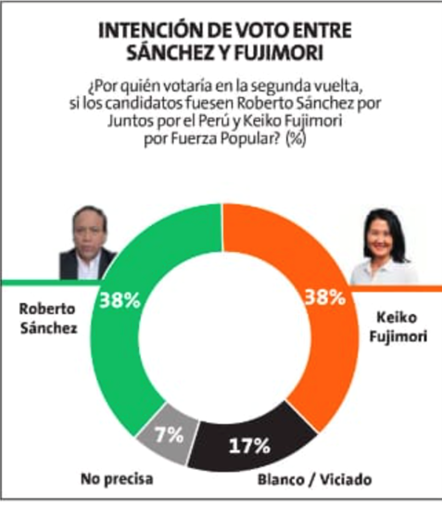
Although the presidential candidate is better positioned to win the presidency in her fourth election campaign, having won comfortably in the first round, the anti-Keiko Fujimori vote is high. In the election, blank and invalid votes (3.1 million) were the winners of the election. The two candidates competing in the election do not even account for 25% of the votes cast combined, not to mention that there was a 23.8% abstention rate. Of the 35 political parties that participated in the election, only six have secured representation in Congress. In Peru, only 19% of the population is satisfied with democracy, the lowest rate in the region after Haiti. The results of the first round of voting reveal a significant lack of representation of Peruvian society.
U.S. interference
That country’s involvement will be a decisive factor in the second round. Peru is one of the key players in the rivalry between the United States and China, not only because of the deep-water port of Chancay and its geographical location, but also due to the significant presence of Chinese capital in the country’s mining and electricity sectors. China is the country’s leading trading partner, accounting for 36% of Peruvian exports, while the United States accounts for only 11.6%.
The U.S. ambassador to Peru, Bernardo Navarro, is similar to the U.S. ambassador to Argentina, Peter Lamelas. Both are political ambassadors, and as Spanish speakers, they navigate the political waters of those countries with ease. The U.S. government will support Fujimori by every possible means, whether visibly (as it did in Argentina during the October legislative elections, or in the Honduran presidential elections in November) or covertly.
Ambassador Navarro arrived in Peru in late January and hit it off with former President José Jerí, who served as Peru’s president from the time Dina Boluarte was removed from office in October of last year until his own dismissal on February 17 due to allegations of clandestine meetings with business leaders and irregular late-night entries into the Government Palace that lasted until dawn. Jerí was one of the first to be invited to join the Shield of the Americas military pact and confirmed his attendance at the official ceremony with Donald Trump, but was removed from office days before. However, Peru’s defense minister did participate in the meeting with 17 other countries at the Southern Command headquarters, attended by Secretary of War Pete Hegseth and Secretary of State Marco Rubio.
Jerí was the main driving force behind the purchase of the U.S. fighter jets. During his short tenure, he authorized the initial transfer of $340 million to begin the process of modernizing the Peruvian Air Force fleet. During his administration, the U.S. bid was selected for “security reasons” and to strengthen the strategic alliance with Washington. Consequently, proposals from Sweden (Gripen) and France (Rafale) were set aside. These negotiations, with congressional backing, were conducted behind the public’s back.
The announcement by current President José María Balcázar to halt the purchase that former President Jerí had already agreed to prompted the resignation of Foreign Minister Hugo de Zela and Defense Minister Carlos Días, and sparked criticism from the country’s leading business and military associations. Business groups are deeply concerned about the imposition of tariffs, despite the fact that Peru has a Free Trade Agreement with the United States—a fact that President Trump could not care less about, as his lack of respect for institutions and international treaties has already led him to impose tariffs on Peruvian exports to the U.S., in violation of the FTA.
The untimely cancellation of the payment by order of the president prompted a reaction from Ambassador Navarro, who stated that same day that, should bad faith be detected in the negotiations, “all available tools will be used to protect and promote the prosperity and security of the United States and the region.” The pressure was intense and yielded favorable results in securing the purchase. Indeed, three days later, a statement from the U.S. Embassy confirmed that the first contract for $2 billion was signed on Monday, April 20, with the “full knowledge of the highest levels of government.” And the Ministry of Economy, contradicting the president, made a transfer of $462 million to the U.S. company.
This left President Balcázar in a very difficult position, as on Wednesday, April 22, he addressed the nation, stating that he had not signed anything and that he maintained his position that such an expenditure should not be made when funds were lacking for education and health care. However, it was President Balcázar himself who signed a Supreme Decree (001-2026-DE) on March 5, which included the purchase of the 24 F-16 aircraft in the “General List of Contracts Declared as Military Secrets.” In it, he granted legal authority to the technical commission and the ministers so that they could sign the contract with Lockheed Martin without the president having to provide a final signature on the purchase document. It was after that announcement that the defense minister and the foreign minister resigned from their posts.
Several legislative blocs have used this crisis to push for a motion of no confidence against the president, accusing him of lying about the existence of the already signed contract and of jeopardizing national security and relations with the United States. The motion of no confidence has been formally introduced, but Congress has not yet proceeded with the final vote on his removal from office. Keiko Fujimori’s party has stated that it would not support the motion of no confidence. It prefers that the transitional government complete its term so as not to increase instability just weeks before the change of leadership. In fact, the new defense minister appointed by Balcázar, attorney Amadeo Javier Flores Carcagno, is a Fujimori supporter, having run for Lima city councilor for the Fuerza Popular party, made financial contributions to that party, and served as an advisor linked to sectors close to the Fujimori faction. Despite the documented ties to Fuerza Popular, Keiko denies them with utter brazenness.
The reality is that Fujimorism has been pulling the strings of power from Congress ever since Pedro Castillo left in December 2022. If Balcázar were removed, the current president of Congress, the ultra-Fujimorist Fernando Rospigliosi, would have to assume the presidency. It is not in Fujimori’s interest to have a Fujimorist in the presidency in the midst of an election campaign. For her, it is better to have a weak and forgetful Balcázar, from the splinter group Partido Perú Libre, as a lightning rod. In any case, the impeachment process in the midst of an electoral crisis is underway, and once López Aliaga resigns himself to the fact that he did not make it to the runoff, the narrative of fraud will continue and will only stop if Fujimori is elected on June 7.
While economic and media power, along with foreign interference, will favor her—and Roberto Sánchez of Juntos por el Perú will be vilified—nothing guarantees that Keiko will not suffer a fourth electoral defeat. One of the central themes of the electoral debate between Sánchez and Fujimori will undoubtedly be the opacity with which these military purchases are made without public debate, against a backdrop of growing wealth concentration and an increasingly marginalized population, as well as automatic alignment with the United States.
Originally published in Spanish April 28, 2026 /es/peru-la-izquierda-y-el-fujimorismo-a-la-segunda-vuelta-y-el-alineamiento-automatico-con-estados-unidos-como-eje-del-debate/

“The World in Focus” is Ariela Ruiz Caro’s column for Mira Feminisms and Democracies. Ariela Ruiz Caro is an economist and currently a researcher at the Center for Development Studies and Promotion (DESCO). She has served as an international consultant on trade, integration, and natural resources at ECLAC, the Latin American Economic System (SELA), and the Institute for the Integration of Latin America and the Caribbean (INTAL), the Andean Community, MERCOSUR and as Economic Attaché at the Peruvian Embassy in Argentina. arielaruizcaro@gmail.com